
DROMONIUS
Development of an automated drone monitoring concept for the surveillance of underground storage facilities
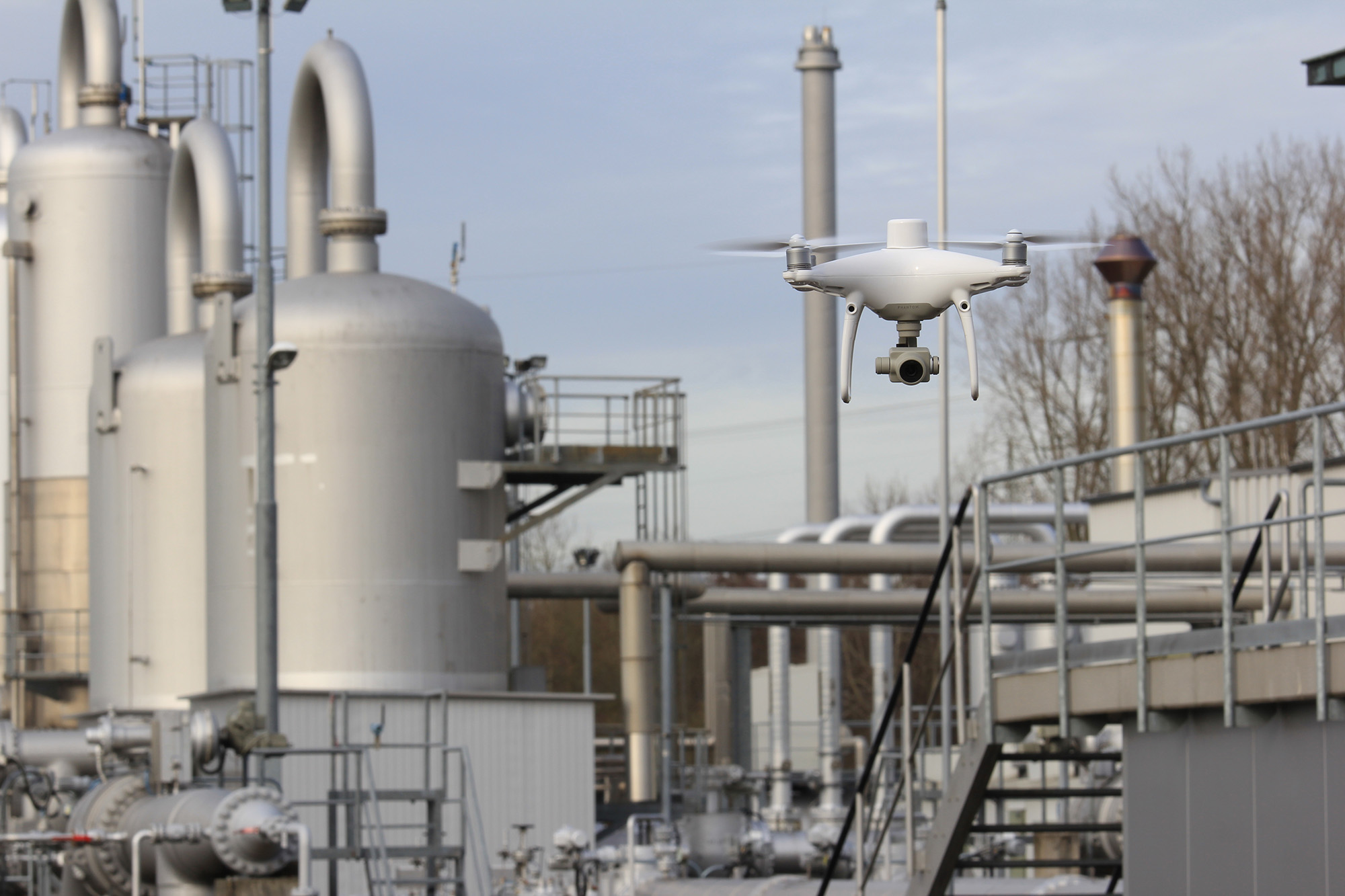
© Stefanie Krause/THGA
In addition to legal requirements and national environmental legislation, the safety-related and environmental monitoring of underground storage facilities for liquid and gaseous energy carriers is becoming increasingly important as a result of the energy transition and the associated expansion of hydrogen infrastructure.
Compared to conventional methods such as manual inspections or helicopter-based surveys, drone-based monitoring systems offer more efficient, cost-effective, and environmentally friendly monitoring. Thanks to automated drone docking systems, they can now also operate fully autonomously.
Project objective
The project “DROMONIUS” aims to develop a scientifically sound, practically applicable, and economically viable concept for an automated drone monitoring system for the surveillance of underground storage facilities. Various sensor technologies (gas, multispectral, thermal) are being deployed, taking into account national, international, and internal operational requirements as well as legal frameworks (drone regulations, mining law, environmental law, process safety, and occupational health and safety).
The result is a feasibility study that will initially be validated at a pilot site. Subsequently, the research findings are also intended to be made applicable to other sites and industries.
Project duration
1 March 2026 – 28 February 2027
Project approach
The project applies innovative remote sensing methods for monitoring large industrial sites, particularly pipelines. Drone-based and site-specific parameters are integrated into an automated workflow and tested for their operational applicability. In this way, modular monitoring methods are developed that can, for example, make potential leaks visible and transparently document the effects of mitigation measures.
Pilot site
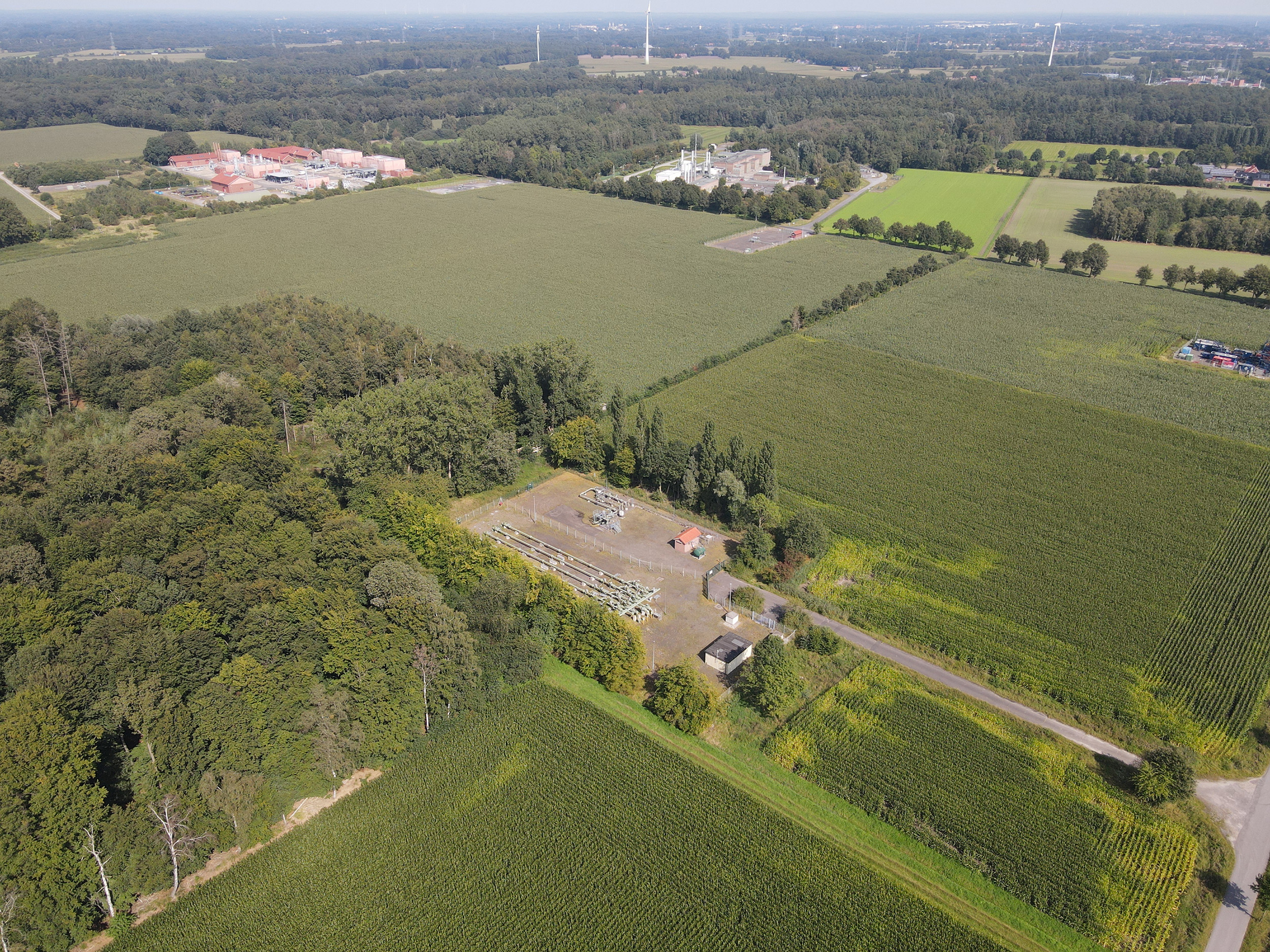
Photo: Benjamin Haske / FZN
A cavern storage facility in Gronau-Epe, operated by Uniper Energy Storage and other companies, serves as the pilot site. Salt has been extracted there for around five decades, and most of the resulting caverns are used for oil and gas storage. Since the first caverns were commissioned in the 1970s, the facility has continuously expanded to a total of 114 caverns with a working gas volume of several billion cubic meters. The site therefore offers ideal conditions for developing and validating the project under real-world conditions. The extensive data and experience from previous projects make this location an optimal candidate for the research project.
Main areas of work
- Systematic analysis of the legal framework for automated drone systems in the energy sector.
- Development of a technical baseline concept for automated monitoring systems, including an assessment of available drone platforms, sensor technologies, and data analysis algorithms.
- Detailed analysis of the reference site, taking into account geographic, meteorological (including seasonal variations), and infrastructural conditions. Integration into existing monitoring concepts and identification of site-specific optimization potential.
- Summary of the findings, economic assessment, risk analysis, and derivation of concrete implementation recommendations in a comprehensive feasibility study.
- Preparation of the final report as well as the drafting and dissemination of scientific publications.
Expected results and benefits
DROMONIUS delivers a scientifically sound, practically applicable, and economically evaluated feasibility study for an automated drone monitoring system. This can be used in subsequent implementati
Project funding
As part of a research cooperation, the research project is funded by Uniper Energy Storage GmbH für eine Laufzeit von einen Jahr (03/2026 – 02/2027) gefördert.
Contact

Jan-Hendrik Sonnhoff, M.Sc.
Technische Hochschule Georg Agricola University
Herner Street 45
44787 Bochum
Building 2, Room 008
Mail jan-hendrik.sonnhoff@thga.de

Dr.-Ing. Benjamin Haske
Technische Hochschule Georg Agricola University
Herner Street 45
44787 Bochum
Building 2, Room 102
Phone 0234 968 3667
Mail benjamin.haske@thga.de

Prof. Dr. Tobias Rudolph
Technische Hochschule Georg Agricola University
Herner Street 45
44787 Bochum
Building 2, Room 101
Phone 0234 968 3682
Mail tobias.rudolph@thga.de

 EN
EN  DE
DE