
METSENSE
Development of an automated low-cost sensor network for continuous methane detection at gas facilities
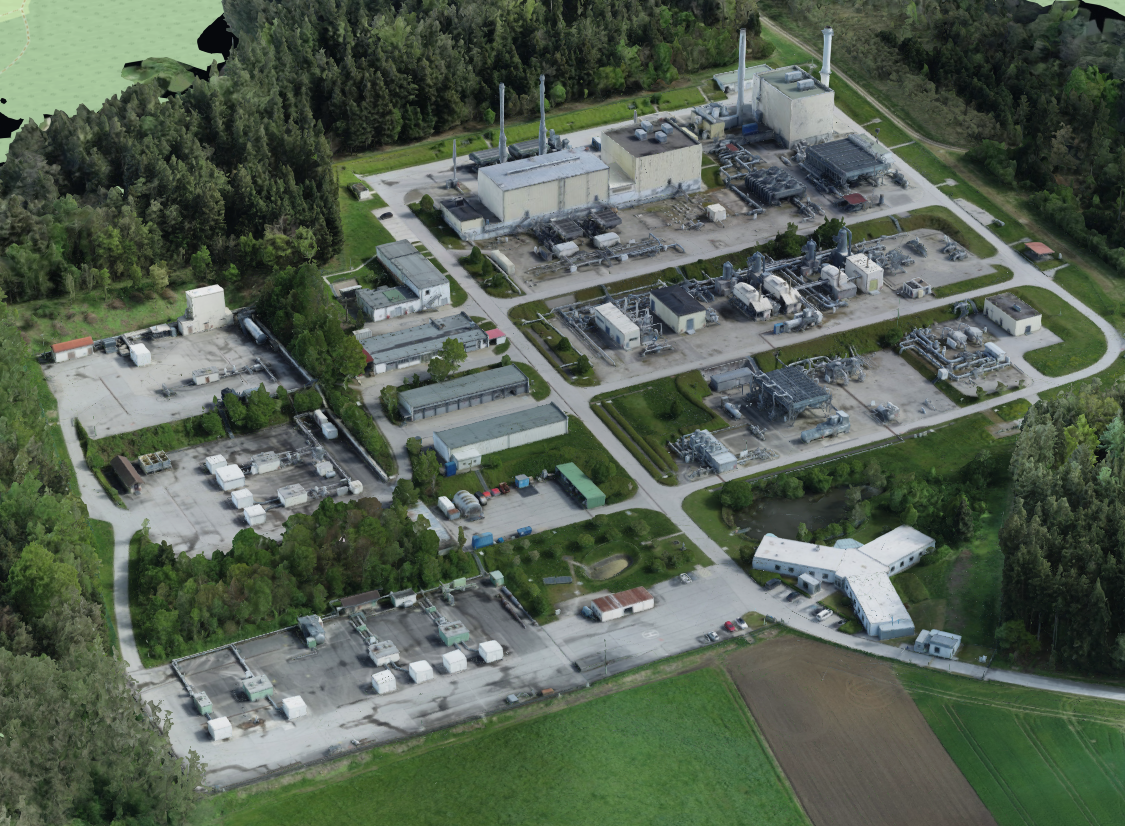
3D model of the UST operational site in Oberbierwang | Image: FZN
The earliest possible detection of gas leaks on operational sites and in their surroundings has been a central task of safety and environmental monitoring in the oil and gas industry for years. With the entry into force of “Regulation (EU) 2024/1787 of the European Parliament and of the Council of 13 June 2024 on the reduction of methane emissions in the energy sector and amending Regulation (EU) 2019/942,” the recording of methane emissions has gained further importance. To address this, the project aims to develop a decentralized sensor network based on low-cost components, with centralized data processing and LoRaWAN transmission.
Project objective
The aim of the research project “METSENSE” is to comprehensively investigate the fundamental feasibility, limitations, and optimization potential of low-cost LoRaWAN sensor networks for methane detection and dispersion modeling. The methodological approach includes both the systematic laboratory characterization of low-cost sensors and extensive long-term field research at the Bierwang porous storage site.
Project duration
1 March 2026 – 31 October 2028
Pilot site
The methodology developed will first be integrated and tested in cooperation with Uniper Energy Storage (UST) at the Bierwang porous storage site, as it represents a particularly interesting research location from a scientific perspective. While the project focuses primarily on the detection of methane, trials on the future-relevant storage of hydrogen are already being conducted at the site. The complex infrastructure offers the opportunity to validate methane detection approaches under real-world conditions and to develop intelligent detection algorithms that make optimal use of the existing sensor infrastructure (wind measurements, meteorological stations).
Main areas of work
- Basic research on sensor performance and methane dispersion
- Method development for intelligent sensor networks
- Empirical long-term research at the Bierwang porous storage site
- Development of transferable methods for other underground storage facilities
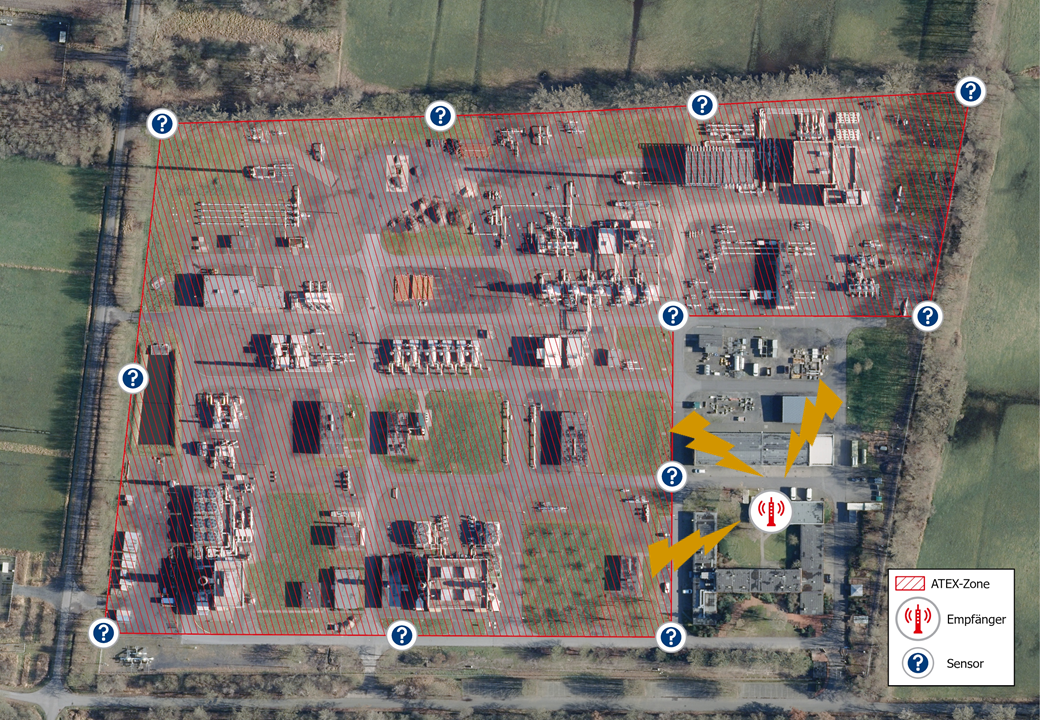
Example sensor network for methane detection at an underground storage site (not to scale) | Image: FZN
Expected results and benefits
New scientific insights are expected into the spatial-temporal dispersion of methane, the intelligent integration of existing infrastructure, the development of predictive monitoring approaches, and the long-term evaluation of the performance of low-cost networks under industrial conditions. The results therefore provide significant added value for transferability to other underground storage sites in national and international practice.
Project funding
As part of a research cooperation, the research project is funded by Uniper Energy Storage GmbH for a project duration of 32 months (03/2026 – 10/2028).
Contact

Saidjamol Akbarov, M.Eng.
Technische Hochschule Georg Agricola University
Herner Street 45
44787 Bochum
Building 2, Room 008
Phone 0234 968 3309
Mail saidjamol.akbarov@thga.de

Dr.-Ing. Benjamin Haske
Technische Hochschule Georg Agricola University
Herner Street 45
44787 Bochum
Building 2, Room 102
Phone 0234 968 3667
Mail benjamin.haske@thga.de

Prof. Dr. Tobias Rudolph
Technische Hochschule Georg Agricola University
Herner Street 45
44787 Bochum
Building 2, Room 101
Phone 0234 968 3682
Mail tobias.rudolph@thga.de

 EN
EN  DE
DE