
© THGA / Volker Wiciok
The Best Practice Guidelines of the European GreenJOBS project have now been published and are freely available. The publication shows how abandoned underground coal mines can create new prospects for renewable energy, the circular economy, and skilled employment – and is aimed in particular at policymakers, competent authorities, mine operators, and other stakeholders working towards a successful structural transition.
With the newly published Best Practice Guidelines, the project GreenJOBS provides a practice-oriented guide for the transformation of former hard coal sites. The publication brings together the project’s technical, economic, and labour-market-related findings and makes them publicly accessible.
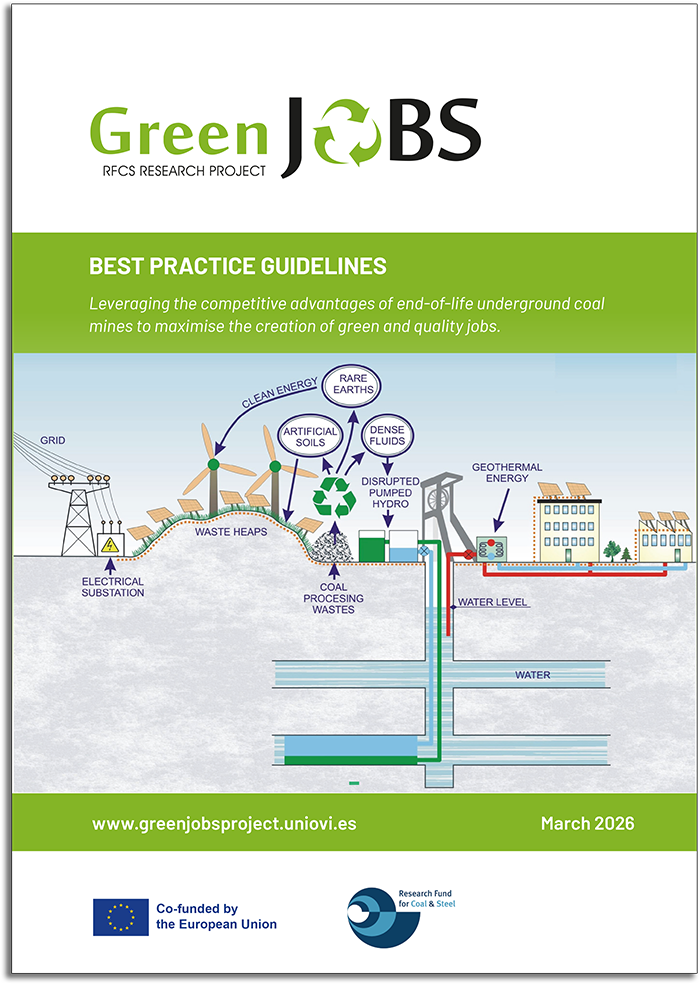
It is aimed primarily at European, national, and regional policymakers and authorities that plan and implement measures for a just transition in coal regions. The English-language publication, titled “Best Practice Guidelines: Leveraging the competitive advantages of end-of-life underground coal mines to maximise the creation of green and quality jobs”, is also intended for owners and operators of abandoned underground coal mines or mines approaching closure. In addition, it offers valuable guidance for environmental authorities, NGOs, investors, project developers, trade unions, educational and research institutions, as well as citizens’ initiatives.
From the Research Center of Post-Mining (FZN), Dr. des. Julia Haske and Dr.-Ing. Tansel Dogan contributed their expertise as specialists in the successful transformation of former mining areas, both within the European GreenJOBS project and in the preparation of the Best Practice Guidelines.
The guidelines show how former mining sites can become hubs for clean energy, energy storage, raw material recovery, and new value creation.

Dr. des. Julia Haske

Dr.-Ing. Tansel Dogan
Topics covered include geothermal energy from mine water, photovoltaic and wind power on spoil heaps, storage solutions, green hydrogen, as well as approaches to the circular economy and land restoration. A particular focus is placed on the question of which occupational profiles, skills, and education and training opportunities are required for this transition.

 EN
EN  DE
DE