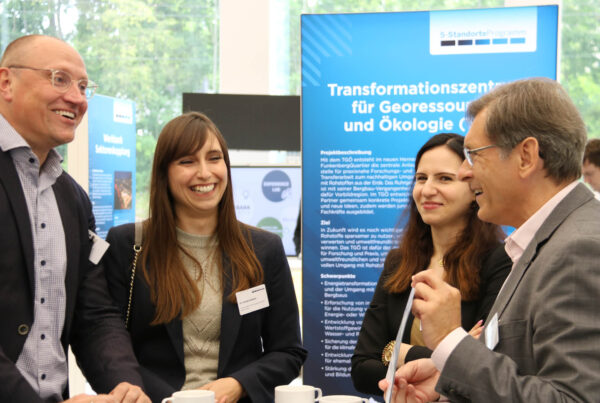
Mine water, risk management, monitoring—when mining ends, it leaves behind a wide range of challenges. How to address these responsibly was the focus of the 21st Altbergbaukolloquium (Colloquium on Abandoned Mining), held on 9–10 November 2023 at the UNESCO World Heritage Site Zollverein Coal Mine Industrial Complex in Essen. Around 500 experts from across Germany gathered at this location of major industrial-historical significance to exchange views on geotechnics, mine surveying, mining, geology and civil engineering. The central question was: What does a future after mining look like? This year’s specialist conference was hosted by the Research Center of Post-Mining at the Georg Agricola University of Applied Sciences (THGA).
“Das Altbergbaukolloquium is one of the most important platforms for exchange among experts working on post-mining challenges and viewing them as opportunities,” said Bärbel Bergerhoff-Wodopia, member of the Executive Board of the RAG Foundation, at the opening of the conference. “Scientific support for the technical processes involved in post-mining, as well as well-trained professionals in this field, are essential to ensuring that both the Ruhr region and mining areas around the world remain desirable places to live.”
“The steady decline in fossil fuel extraction is shifting the focus to the winding-down of mining operations and the resulting tasks of the post-mining era,” added Heinrich Böckelühr, President of the Arnsberg District Government. “Examples include the planned rise in mine water levels in the state’s hard coal mining regions and the repurposing of former mining sites to further develop North Rhine-Westphalia as an industrial state. This also includes expanding geothermal energy and underground storage.”
UNESCO World Heritage Site Zollverein was therefore deliberately chosen as the conference venue. “It is an important landmark and a source of identity for the entire region,” says Prof. Dr Christian Melchers, head of the Research Center of Post-Mining in Bochum. “From here, there are numerous opportunities to explore mining’s legacy and develop innovative ideas for former mining regions. And for us as researchers, it is even an oversized real-world laboratory.” The Research Center of Post-Mining is currently conducting several projects on the former colliery site.
The practical relevance of current research topics was also reflected in the diverse presentation programme of the 21st Abandoned Mining Colloquium. Topics included, among others, the sustainable management of mine water, increasing digitalisation in abandoned and post-mining contexts, the impact of climate change, and specific remediation strategies for old shafts, spoil heaps and entire industrial facilities.
A tour of the current shaft construction site at Zollverein Colliery rounded off the conference programme. Once Europe’s most productive coal mine, Zollverein ceased production in 1986 and is now a business, education and cultural hub. By 2024, it will have been converted into a mine-water management facility, serving as a key pillar of the mine-water concept. In future, no people will travel underground here; only pumps will carry out the work. In small groups, participants were given rare insights into the ongoing work and learned about the challenges and requirements involved in the conversion.
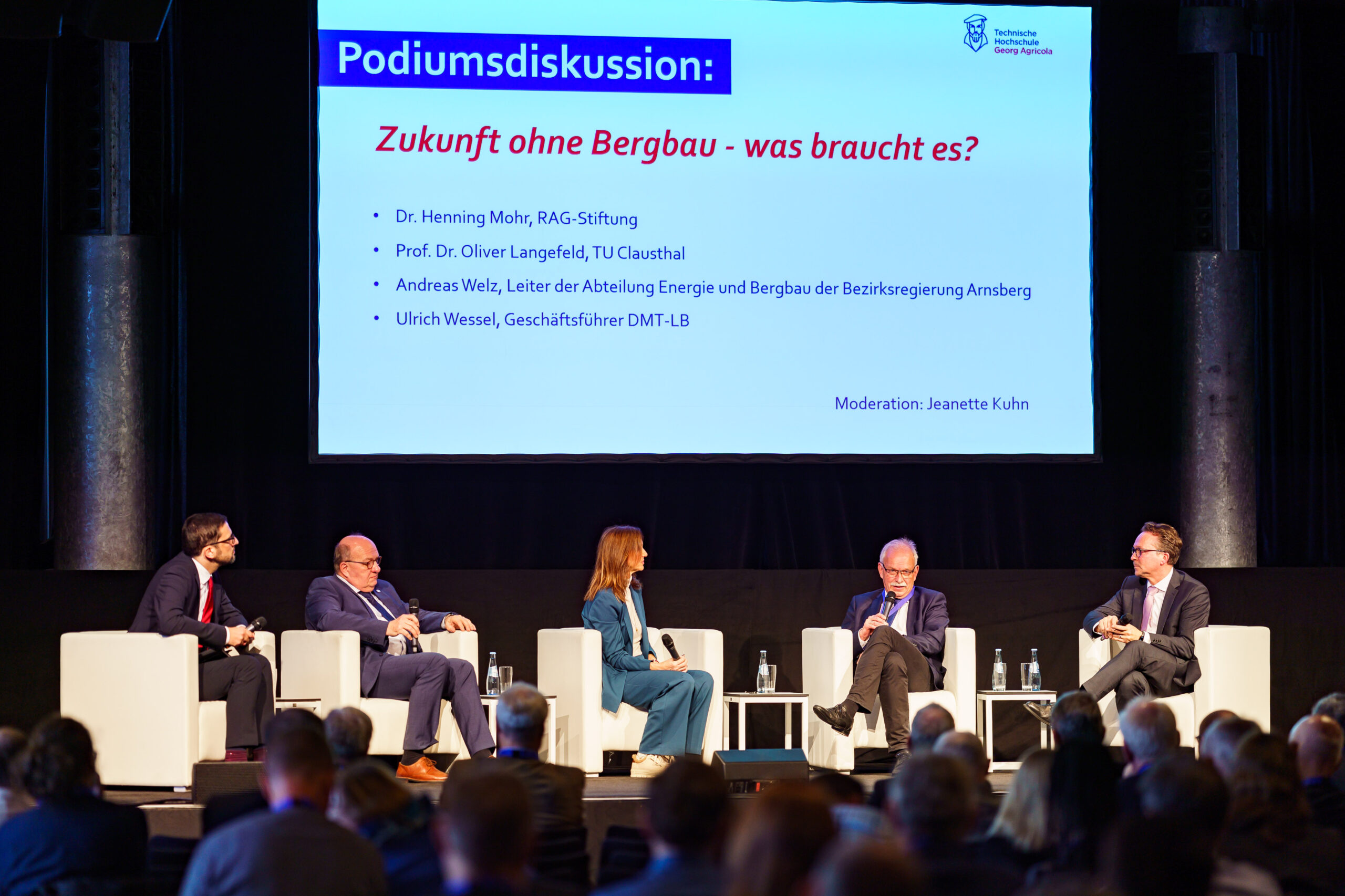
Diskutieren die zukünftige Rohstoffwelt (v.l.n.r.): Dr. Henning Mohr von der RAG-Stiftung, Prof. Dr. Oliver Langefeld von der TU Clausthal, Moderatorin Jeanette Kuhn, Andreas Welz von der Bezirksregierung Arnsberg und Ulrich Wessel, Geschäftsführer der DMT-LB.